Learn about bats and the other animals that use echolocation to help them “see” their world.
Bat Echolocation
Being nocturnal creatures, bats benefit greatly from the use of sonar which allows them to navigate during the night and in dark places where there are plenty of night time insects for them to feed on, but few other predators can function efficiently making it safer for the bats to be out and eliminating most of the competition.
While the range of sound for a human is only 20 to 20,000 Hz, a bats range can be from 14,000 to well over 100,000 Hz. Certain
ranges; however, are preferred by specific species of bats which can help researchers identify which bat species may be in a particular area merely by monitoring which range of frequencies are being used.
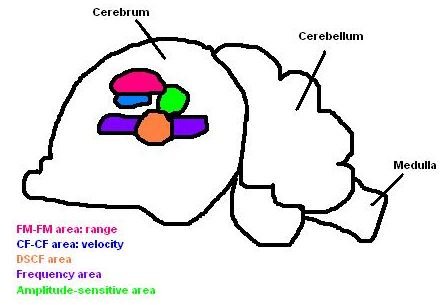
To help them utilize these ranges, which are far outside the normal hearing abilities of human beings, bats have very acute inner ear structures that allow them to pick up the range of frequencies. With a rather large auditory cortex, bats are are quite suited for using echolocation, so well in fact, that they can operate and navigate their way around in complete darkness. The cortex includes various areas that are specialised for the use of biosonar and for picking up different frequencies as pointed out in this illustration.
Other Animals That Use Echolocation
Although bats definitely rule the night in the world of sound, there are a other animals that find their way around the night by using sound. Certain nocturnal birds such as oilbirds and a few species of swiftlets use sound to help them find their way around the night. While their use of sound is not nearly as sophisticated as it is in bats, it is still a very useful skill that helps the night time birds to survive in the ark environment.
Other animals, such as shrews, have also been known to use a type of biosonar to help them function in their habitats. Although for shrews, this function seems to be more of an attempt to gather information about the overall environment and is not used for hunting food the way it is in bats.
Human Echolocation:
There have even been some cases of humans using this method as well. Generally used by those who have lost their eyesight, or who were born blind, they seem to have a highly developed sense of hearing to compensate for the loss of site. This hypersensitivity to sound has allowed some individuals to employ echolocation methods to navigate their way around a world that they can not see.
There are three very notable cases in which the use of human echolocation has been documented including James Holman (known as “the blind traveler”), Daniel Kish, Ben Underwood.
To learn more about human echolocation refer to the following articles:
The Boy Who Sees with Sound - Human Echolocation
This post is part of the series: Hearing Your Way Around: How Echolocation Works
Learn about echolocation, how it works, and what animals employ this method.